Alberte Goldschmid's Fatal Traffic Accident
The Hanging GirlAlberte Goldschmid’s fatal traffic accident is reconstructed through clues that point in different directions: her unexplained early-morning bicycle ride and the physical mechanism that sent her into a tree. Carl’s measurements make a meeting place seem possible, not proven. Later technical findings, meanwhile, undermine the theory that a board recovered from the water caused the collision’s extraordinary outcome. The investigation advances by narrowing possibilities, but neither line of inquiry yet establishes exactly what Alberte was doing or how the vehicle struck her.
Background and the Unanswered Journey
Carl studies a notice board crowded with newspaper clippings, photographs, map fragments of Bornholm, and colored pins. Arranged together, the collision scene, the community hall in Listed, the folk high school, and other people and places appear to form a simple case: a young woman was killed, and an investigator wanted to find the person responsible. But the apparent overview produces more questions than answers. The most pressing concerns why Alberte had cycled early in the morning to a side road some distance from the school, a place Carl thinks must have mattered to her.
A meeting with the man she was infatuated with offers an attractive explanation, but Carl recognizes that it is only a possibility. The evidence does not establish that the two had arranged to meet, whether the arrangement was made the day before, or whether they used the same time and place repeatedly. She might instead have gone to check for a message. The police found no note; Carl considers both that none had been left and that one might have been removed afterward. These alternatives keep the apparent romance from becoming a settled account of the journey.
Mapping a Possible Meeting Place
Carl recalls that Alberte cycled frequently, loved the surrounding countryside, and was usually away for only half an hour, according to the caretaker at the folk high school. He uses those details to test the distance she could have covered. Estimating that she might have ridden at least twenty kilometers an hour, he reasons that a destination no more than five kilometers away would allow time to travel there and back and remain for a few minutes.
He takes a compass, measures five kilometers using the map’s scale, places one leg at the school, and draws a circle around it. The tree where Alberte was found lies inside the radius. That result makes the tree a plausible meeting place or a location where two people could leave messages for one another. Its potential as a romantic rendezvous also sharpens the contrast with what followed: whatever significance it had for Alberte, the location became the setting associated with her death. Yet the circle proves only that the trip fits the proposed time and distance. Carl explicitly resists treating the map as proof, and the possibility that Alberte went there for a note leaves open the chance that she went in vain.
Physical Evidence and the Limits of Reconstruction
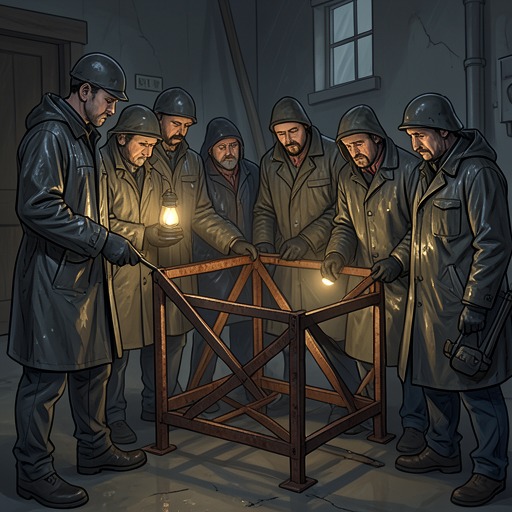
A technical review addresses a different uncertainty: what object, if any, helped propel Alberte into the tree. The technicians confirm that the recovered splinter was plywood, but conclude that the board found in the water was not the board that sent her there. The boreholes described by Christian Habersaat could not, on their own, have served to attach that board to a vehicle such as the Kombi. Hooks through the holes might offer one explanation, but the investigators cannot identify where such hooks would have been fastened.
The proposed attachment point beneath the windshield wipers creates a further problem. If hooks had connected the board to the furrow with its rubber gasket, technicians reason that both the windshield and the board would have been thrown around. They would expect to find traces of them even if someone had thoroughly cleaned the scene; the examination, however, gave no indication that such a cleanup had occurred. The absence of those expected traces weakens the proposed mechanism rather than supplying a replacement for it.
The fender alone, the technicians also report, would not have been sufficient to throw Alberte into the tree. Their assessment is that the force would have required a properly adjusted shovel blade. This finding distinguishes the physical capacity needed to produce her trajectory from the board actually recovered: the board does not fit the evidence, while a shovel blade is identified as necessary to the result. It does not, by itself, identify the object used in the collision or explain how it was mounted.
An Accident Still Unresolved
The investigation therefore holds two provisional reconstructions at once. Carl’s circle shows that Alberte could have reached the tree and returned within her usual half-hour absence, making a rendezvous or message point feasible. The technical examination, by contrast, rejects the recovered board as the implement that launched her into the tree and indicates that the fender alone could not account for what happened. Neither conclusion supplies the missing certainty: the map cannot tell Carl why Alberte went there, and the physical findings do not settle how the fatal collision was engineered. The accident remains a problem of inference, with a plausible destination and a disputed mechanism but no complete account.